
Key takeaways
- Picks secure heroes for a team, while bans remove heroes from the shared pool for that game.
- Ranked All Pick and professional Captains Mode use different drafting systems and should not be treated as the same mode.
- Strong drafts balance lanes, roles, control, damage, objectives, scaling and execution instead of relying on one counterpick.
- Draft rules can change with patches or tournament settings, so exact timings and phase orders should be checked against the current client or event rules.
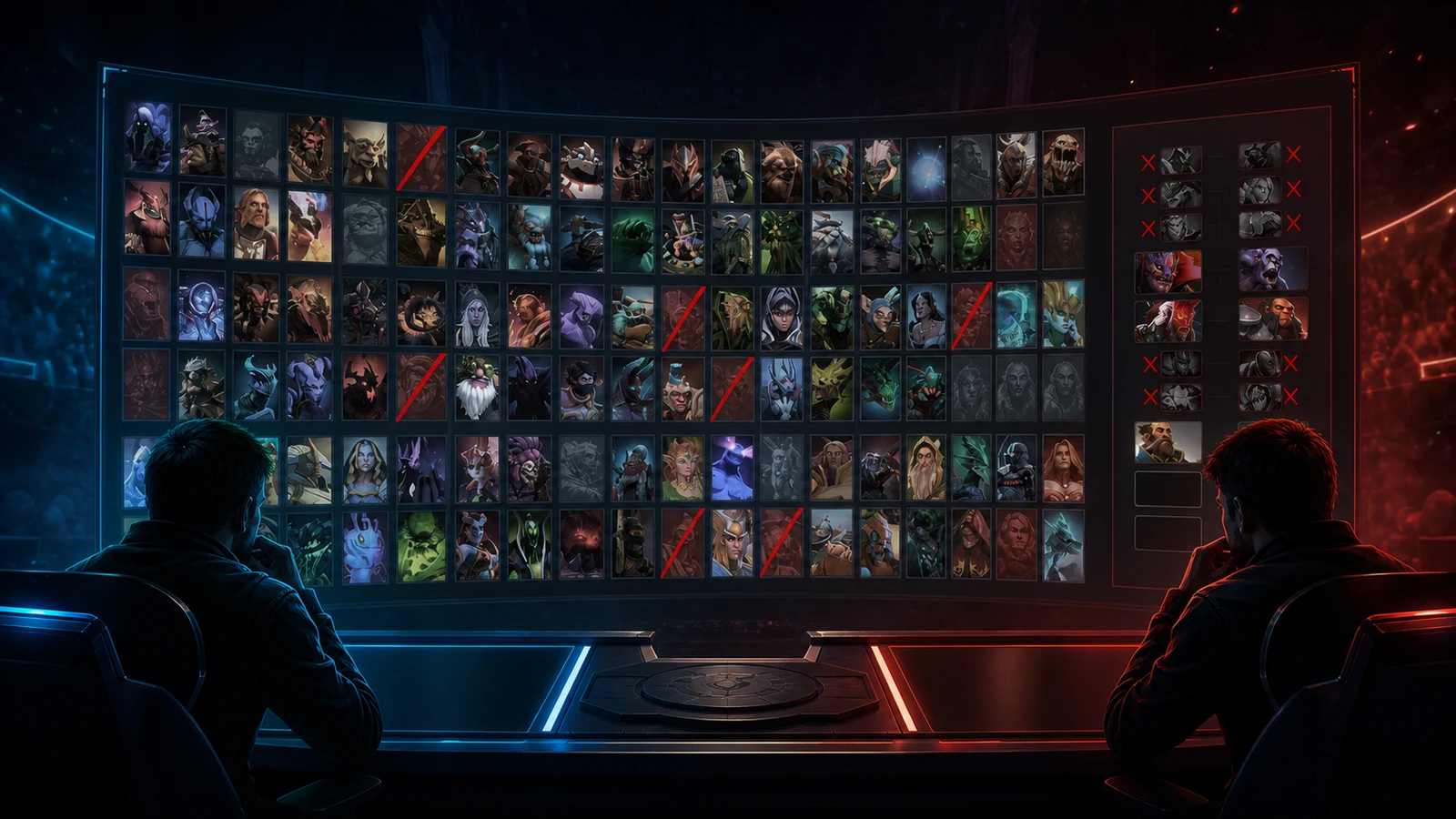
Dota 2 picks and bans are the decisions that build both teams before the action starts. A pick reserves a hero for one side. A ban removes a hero from the shared pool so neither team can use it in that game.
The draft is more than a formality. Every choice can reveal a lane, protect a strategy, deny an opponent’s comfort hero or force the other team to solve a new problem. In professional Dota 2, this turns the drafting phase into a strategic contest between captains and coaches before the players ever reach their lanes.
There is one important distinction for new viewers: ranked All Pick and competitive Captains Mode do not use the same process. The goals overlap, but the people making the decisions, the information available and the order of the choices are different.
Dota 2 picks and bans at a glance
| Draft action | What it does | What it can reveal |
|---|---|---|
| Pick | Secures one hero for a team | A role, lane, combo or overall strategy |
| Ban | Removes one hero for both teams | A feared counter, meta priority or targeted player concern |
| Flex pick | Secures a hero that can fill multiple jobs | Very little until later choices define its role |
| Denial pick | Takes a hero the opponent also wants | Draft priority and knowledge of the opposing plan |
| Target ban | Removes a player's signature or comfort hero | Preparation for a specific opponent |
A draft is complete when each team has five legal heroes. What happens between the first ban and the last pick depends on the game mode and the current rules.
Ranked All Pick and Captains Mode are different
Ranked All Pick
Ranked All Pick is the matchmaking draft most players encounter. Players can participate in the ban process, then choose their own heroes during pick rounds. Opposing choices may remain hidden until a round resolves, preventing one side from immediately countering every individual selection.
This is the context behind a common player question: why does a nominated ban sometimes remain available? The short answer is that a ban nomination is not always the same as a guaranteed manual ban. Valve has revised the All Pick ban system several times, so the game may process nominations according to the active patch’s matchmaking rules.
The same warning applies to two players attempting to select the same hero during a hidden pick round. Historically, All Pick has used conflict handling that blocks or resets a contested selection rather than awarding the hero based on who clicked first. The exact response can change, which is why an older Reddit explanation may describe behavior that no longer matches the current client perfectly.
For the active rules, treat the pick screen itself and the latest official patch notes as authoritative. The evergreen principle is simpler: matchmaking uses a structured draft to reduce instant counterpicking and resolve contested heroes fairly.
Professional Captains Mode
Captains Mode is the standard concept used for organized competitive drafting. One captain controls the five picks and the team’s bans, although teammates and coaches can contribute to the plan where tournament rules allow it.
The teams move through staged ban and pick phases. Each new phase adds information: early selections establish priorities, middle choices begin to define lanes and the last picks often complete or challenge the final matchup structure.
Tournament administrators can set the game version, hero pool and lobby rules. Valve has also changed Captains Mode phase orders and timers in past updates. That means a guide should not freeze one historical sequence and present it as permanent. When an exact order matters, check the current event rulebook and in-game lobby.
What happens before the first pick?
Before a professional draft begins, the teams must resolve two separate choices:
- Which side of the map each team will play: Radiant or Dire.
- Which team receives the first-pick or second-pick draft order.
Events decide priority through their own series rules, often using a toss or alternating choice procedure. Side and pick order are related strategically but are not the same decision.
First pick provides access to the opening hero of the draft, which matters when one option is significantly more contested than the rest. Second pick can offer a paired response at certain points in the sequence and may preserve the final answer in a later phase. Neither is automatically better in every patch; the value depends on the hero pool, map balance and the team’s prepared strategies.
How professional teams use each draft phase
The exact number and order of selections can move over time, but the strategic purpose of an opening, middle and closing phase remains useful for spectators.
Opening bans: remove the biggest problems
Opening bans usually focus on heroes a team does not want to trade through the first phase. These may be:
- the strongest heroes in the current competitive patch;
- an opponent’s most successful comfort picks;
- flexible heroes that are difficult to read;
- heroes that directly enable a known strategy; or
- counters to a planned first pick.
A target ban does not necessarily mean a hero is universally overpowered. It may simply have unusual value for one player or one matchup. Good preparation is specific.
Opening picks: strength without overcommitting
Early picks need to be strong enough to justify revealing them while leaving room for adjustment. Teams value heroes that can enter several lanes, perform more than one role or work with different partners.
This is why viewers often see supports or offlaners selected early, but it is not a fixed rule. A carry or mid hero can be an opening priority when it is highly contested, difficult to counter or flexible enough to hide its destination.
The real goal is to spend an early pick without giving the opponent a complete map of the lineup.
Middle bans and picks: strategies become visible
Once several heroes are known, both sides can ask more specific questions. Does the opponent need teamfight? Is its carry vulnerable to illusions? Does a support pair lack reliable lockdown? Is one lane already obvious?
Middle bans protect what a team has shown and attack what the opponent still needs. Middle picks then connect the lineup. A team may add initiation, save, tower pressure, Roshan damage or a lane stabilizer rather than selecting the highest-rated hero in isolation.
This is also where role flexibility becomes valuable. If one hero can move from support to core, the opponent may spend a ban solving the wrong version of the draft.
Final picks: complete the lineup, not just the lane
Last picks receive the most information, so they often attract attention as counters. A strong final choice can punish a weak lane, exploit a damage-type problem or select a core that the enemy lineup cannot easily reach.
But a last pick still has to fit the whole team. Winning one theoretical matchup does not help if the final lineup has no building damage, no reliable initiation or three heroes competing for the same safe farm.
The best final picks solve several needs at once.
How to read a Dota 2 draft like a spectator
Instead of asking only which team has more meta heroes, check whether each lineup can answer the following questions.
1. Are the lanes playable?
Look at the likely lane combinations, not only one-versus-one counters. Supports affect early matchups through stuns, saves, trading strength and rotations. A difficult lane can be acceptable if the team has a recovery plan, but three weak lanes usually create an immediate execution problem.
2. Who starts a fight?
Every lineup needs a practical way to act. That can be a long-range catch spell, a mobile initiator, vision advantage or enough tower pressure to force the opponent into one area.
A draft with powerful damage but no reliable opening may spend the game reacting instead of choosing fights.
3. What control is available?
Stuns, silences, roots, displacement and area denial determine whether damage can actually connect. Consider spell immunity, dispels and defensive saves as part of the same problem. Control that looks sufficient on paper can fail if it is too short-ranged or attached to one fragile hero.
4. How does the team take objectives?
Kills are a means, not the win condition. Check which lineup can damage towers, threaten Roshan, control an area and convert a won fight into something permanent.
A team with excellent teamfight but slow objective damage may give the opponent repeated chances to recover.
5. When is each lineup strongest?
Some drafts want to group early around spells and summons. Others need levels, key items or a late-game carry. Compare the timing windows rather than declaring one lineup better for all 60 minutes.
A scaling advantage matters only if the team can survive long enough to reach it. An early advantage matters only if it can be converted before the opponent’s next power spike.
6. How difficult is the draft to execute?
Two lineups can have similar theoretical strength but very different margins for error. One may need perfect positioning and layered cooldowns; the other may have clear initiation and forgiving saves.
Execution difficulty is part of draft quality, especially in elimination matches or against a team known for forcing chaotic fights.
Why teams ban comfort heroes
A comfort hero carries more value than its public win rate suggests when a particular player understands every lane, timing and matchup. Removing it can force that player onto a less-practiced option and make the opponent’s wider plan easier to predict.
Target bans can also test roster depth. If several bans are spent on one role, the targeted player may still find a suitable hero—but the other four players gain access to more of the general hero pool. Drafting is always a trade: every targeted ban leaves something else available.
This is why a long list of bans against one star can be both respect and strategy. It does not prove the player can use only those heroes.
What makes a strong flex pick?
A flex pick threatens more than one believable role or lane. The word believable matters. Moving a hero somewhere it technically can play is not useful if the alternative role is too weak for the match.
Strong flex heroes usually share several traits:
- they contribute with levels or utility before expensive items;
- they can partner with different lane heroes;
- their core spells remain useful from more than one farm position;
- they do not expose the team’s primary damage source too early; and
- the roster has practiced the different configurations.
The advantage is information. The opponent may know the hero but not which player will use it, what lane it will enter or which later pick it is preparing.
Can a draft decide the game?
A draft can create a major advantage, but it does not play the match. Lane execution, item choices, vision, objective decisions and teamfight coordination still determine whether the theoretical plan works.
Calling a draft “unplayable” should require more than one counterpick. A useful analysis explains the mechanism: perhaps one team cannot start fights through saves, has no answer to a specific late-game hero, or must win before a clear timing deadline.
That explanation is more valuable than counting heroes that analysts liked in the previous tournament.
A quick draft checklist
When watching the next match on the Dota 2 schedule, use this checklist after the tenth pick:
- Identify the likely lanes and role assignments.
- Find each team’s initiation and defensive save.
- Compare physical, magical and pure damage answers.
- Check tower and Roshan pressure.
- Mark the most important item and level timings.
- Decide which team wants a fast, controlled or extended game.
- Note which lineup is easier to execute when behind.
Then compare your read with the actual Dota 2 results and the available picks, bans and player data on supported match pages. The EsportsNews.pro data methodology explains when those details appear and why unavailable fields are not filled with guesses.
Rules change, drafting principles last longer
The Reddit discussion supplied for this guide is useful because it captures genuine confusion around ban nominations and simultaneous picks. It was published in 2022, however, so its exact percentages and client behavior should be treated as historical rather than guaranteed current rules.
The same applies to older official patch notes and educational videos. They show why the draft works the way it does, but Valve can change phase order, timers, ban counts and matchmaking logic. Tournament organizers can also define lobby settings in their rulebooks.
For readers, the durable lesson is this: picks create a lineup, bans control the remaining possibilities, and every phase exchanges hero strength for information. Learn to read lanes, roles, timings and objectives, and the draft becomes a clear preview of the match rather than a wall of portraits.
Sources and further viewing
- Reddit r/learndota2 discussion: how ranked All Pick phases work — community discussion published in 2022; mode-specific details may now be outdated.
- Yahoo Southeast Asia spectator guide to the Dota 2 drafting stage — video reference and transcript supplied by the site owner.
- Valve Dota 2 Gameplay Update 6.87 — historical example of Valve changing Ranked All Pick and Captains Mode rules.
- BLAST Dota Slam 2026 rulebook — current tournament example specifying Captains Mode and event lobby rules.
Frequently asked questions
What are picks and bans in Dota 2?
A pick reserves a hero for one team, while a ban removes a hero from the available pool for both teams. Together, the choices shape each lineup before the match begins.
Is a ranked All Pick ban nomination always guaranteed?
Not necessarily. Valve has changed ranked ban systems over time, and a nomination may be processed by the current matchmaking rules rather than acting as a direct guaranteed ban. Check the current in-client explanation for the active patch.
What is the difference between All Pick and Captains Mode?
In ranked All Pick, individual players choose their own heroes through matchmaking's pick rounds. In Captains Mode, a captain controls the team's staged picks and bans from a shared hero pool, which is why it is used for organized competition.
Why do professional teams pick supports early?
Teams often open with reliable or flexible heroes that reveal less about the final lane setup. This can include supports, but any hero may be picked early when it is highly contested or central to the team's plan.
What is a flex pick in Dota 2?
A flex pick is a hero that can plausibly play more than one role or lane. It preserves options and makes it harder for the opponent to identify the lineup and choose precise counters.
Verified data and editorial standards
Schedules and scores use the site’s published API data. Guides are written and reviewed by the EsportsNews.pro editorial team, while unverified details are omitted.